POV

role

Product Manager & Playtest Lead

timeline

Mar - Apr 2026

context

CS247G, Stanford

key skills

  • Usability Testing
  • A/B Testing
  • Feature Descoping
  • Accessibility Audits

overview

POV is a print-and-play party game where 5 to 8 players take on dramatic character roles to build one unscripted story together. I worked on a four-person design team to take the game from concept to prototype to public release, designing a fast, structured format that lets any group finish a full story in two rounds without prior gaming or improv experience.

problem

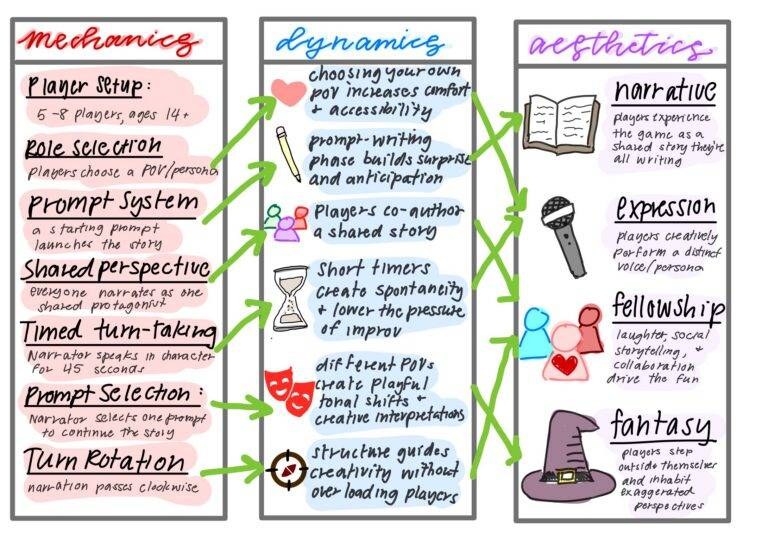
Existing storytelling games put an intimidating creative burden on players by asking them to invent stories from scratch, while deduction games like Mafia and Fibbage rely on high-stress deception and social exclusion. After running competitive teardowns of both categories, I saw a gap for a cooperative game that rewards creativity and roleplay while using structured prompts to ease social anxiety. Before prototyping, my team and I built a concept map and an MDA model to scope the MVP down to the core loop and the few mechanics that directly supported the experience we wanted players to have.
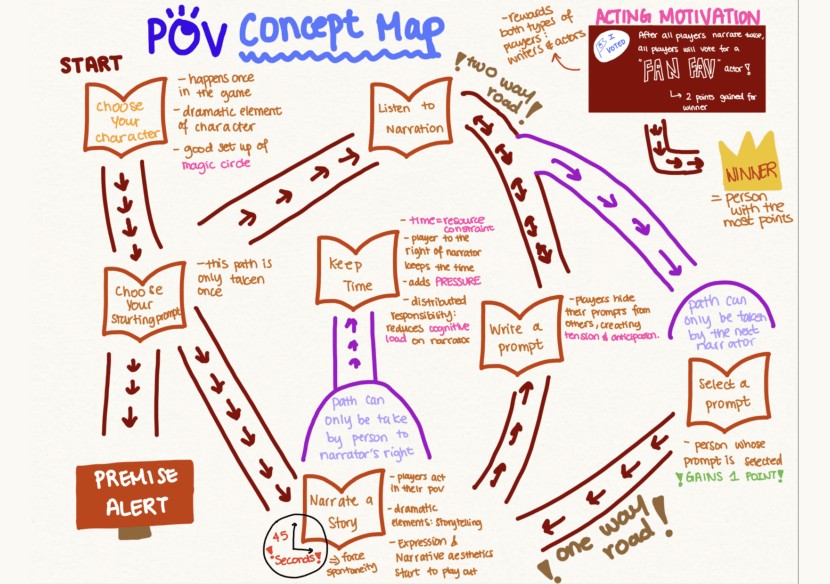
Hand-drawn concept map of POV's game loop: choose a character and starting prompt, listen to narration, write and select prompts, keep time, and narrate a story
A concept map of POV's core game loop, showing the order of each phase, who can take each path, and where timers and voting add pressure.
Hand-drawn MDA model linking POV's mechanics to dynamics and to the aesthetics of narrative, expression, fellowship, and fantasy
An MDA mapping of how each mechanic creates the dynamics behind the four aesthetics my team and I designed for: narrative, expression, fellowship, and fantasy.

target users

I designed for casual party game players, families, and college students who want a funny, expressive activity but feel intimidated by complex tabletop systems like Dungeons & Dragons. Through user journey mapping, we found they love playing over-the-top personas but need game-enforced time limits and structured prompts to feel safe enough to improvise.

pain points

The first prototype was feature-heavy, and the usability playtests we ran revealed severe cognitive overload. Each turn, players juggled 5 tasks at once: acting out a secret character, hiding that identity, secretly weaving 3 plot quests into the story, tracking other players to guess their roles, and writing story continuations on a timer. I quickly learned that the complexity killed the humor and made players too cautious to take creative risks.
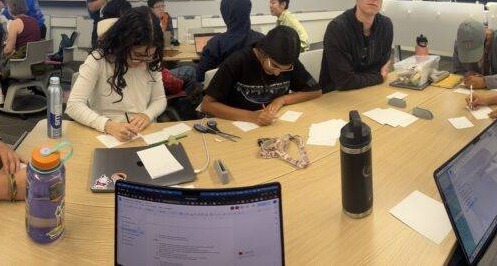
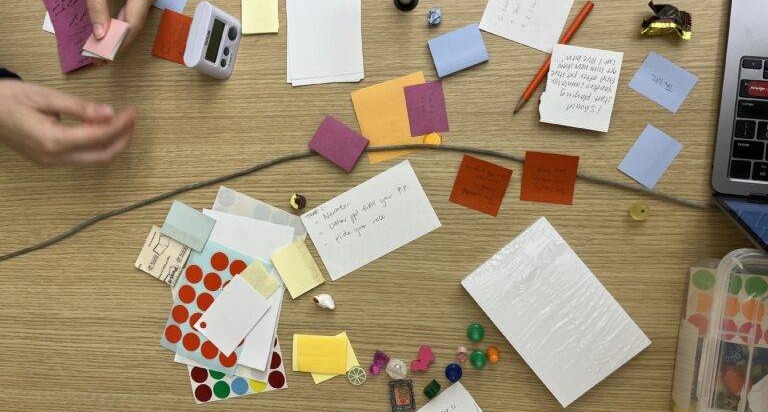
Players writing prompts around a table during a POV playtest in class An early POV prototype made of sticky notes, index cards, a timer, and tokens spread across a table

solution

Across five playtests, I cut conflicting mechanics to lower cognitive load and keep the focus on storytelling:

Cut 3 overloading mechanics

Removed hidden roles, role deduction, and secret plot quests by making all character cards face-up as POVs, reducing tasks per turn from 5 to 2.

Paced the narration

Shortened narration from 1 minute to 45 seconds to spark spontaneity and keep momentum high.

Added an engagement engine

Introduced a 45-second prompt-writing phase and a Fan Favorite vote to reward theatrical play.

impact

A/B tests were conducted across 2 rounds on character onboarding, plus an accessibility audit of the printed materials:

Self-selection won

Letting players choose their own POV instead of dealing cards at random built an instant connection to their character, with noticeably more laughter, acting, and participation.

Designed for every player

I chose color-contrast combinations suited to players with color vision differences, and switched prompts from orange sticky notes to white cardstock after players struggled to read them in low light.

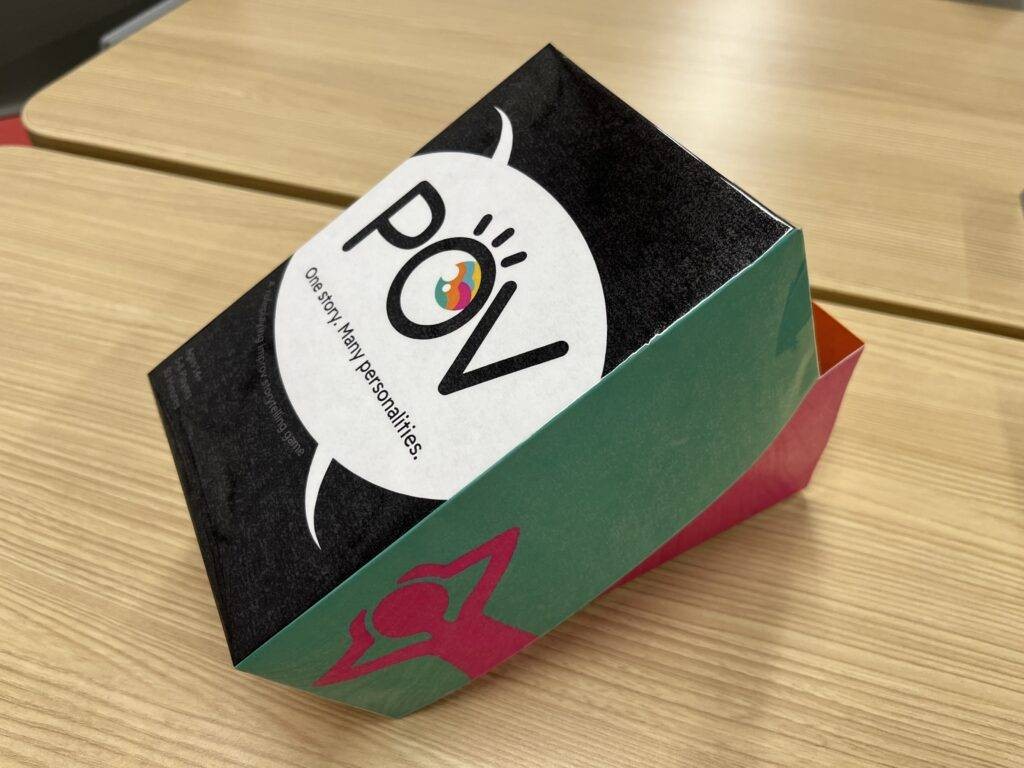
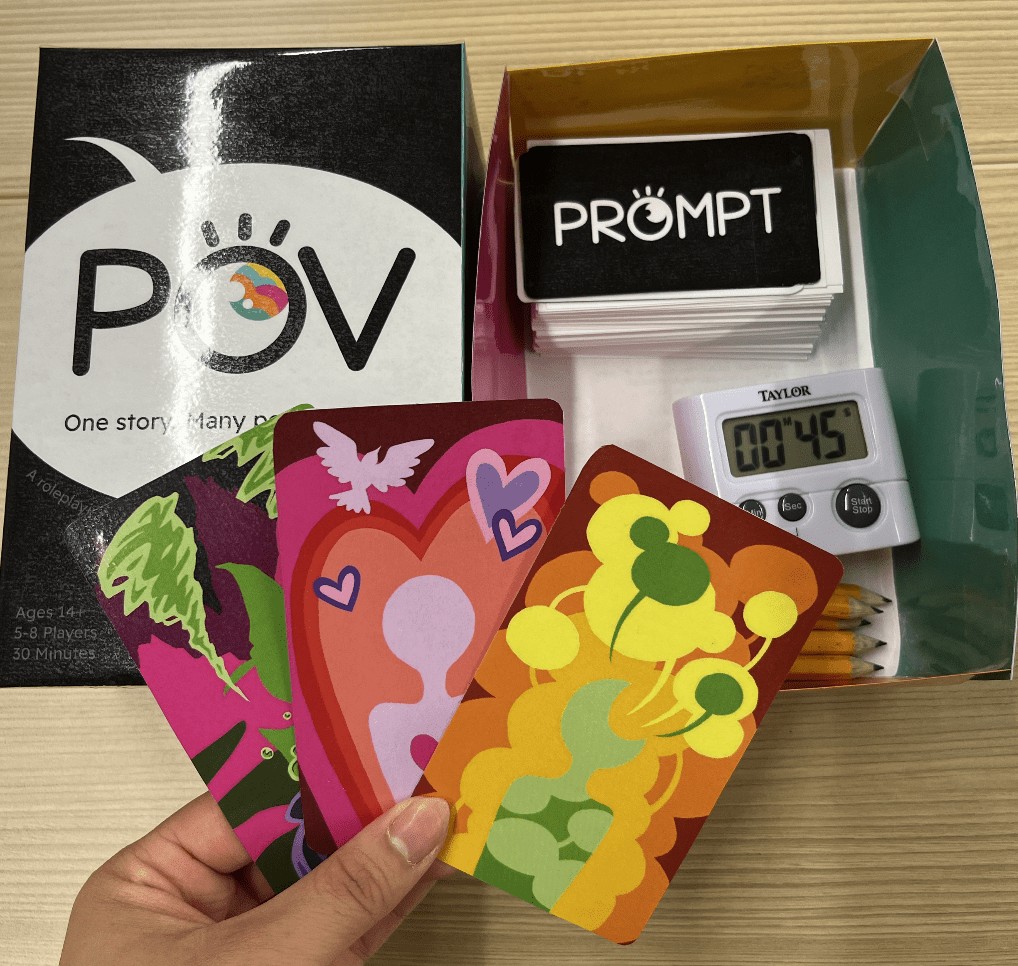
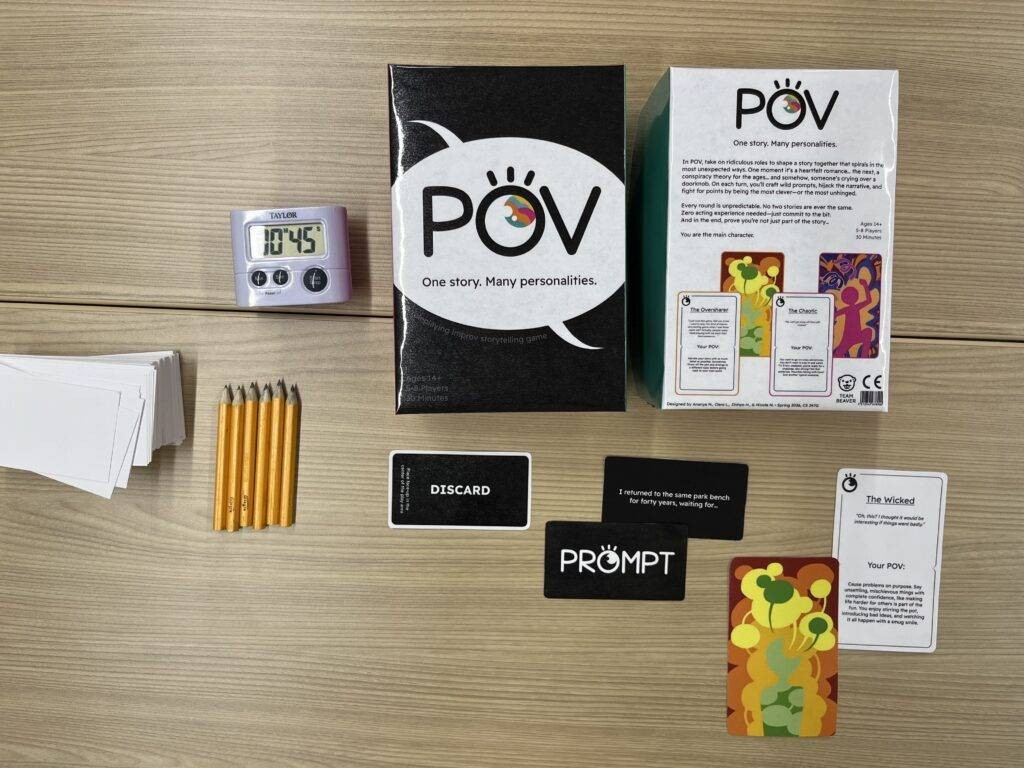
The POV box lid at an anglePOV box open with prompt cards, a timer, and character cardsPOV game components laid out on a table
back to projects